AI Testing Tools: How I See Them Changing Software Testing Today
20 Jan, 2026
9903 Views 7 Like(s)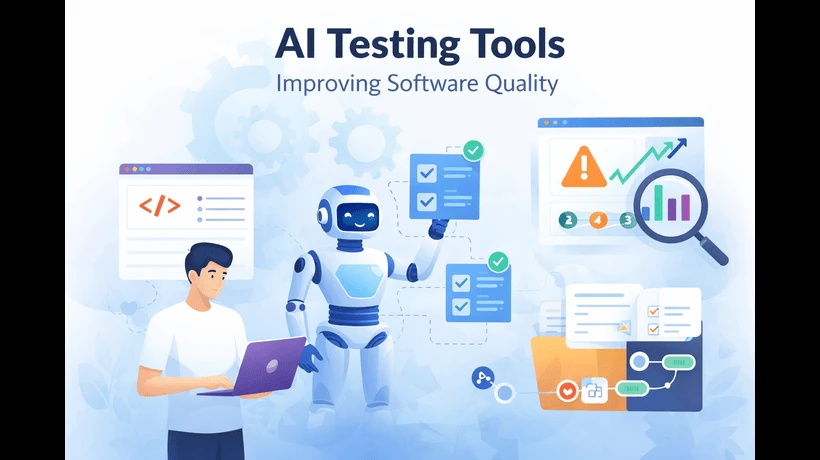
AI testing tools are changing how modern teams ensure software quality by using machine learning and real usage data instead of fixed rules. This enables smarter test creation, self-healing automation, and better test prioritization. As a result, engineers spend less time on maintenance while improving test reliability. For fast-paced teams, AI-supported testing is now a practical reality, not just a trend.
Testing used to feel predictable. Now, with faster releases and complex systems, it feels like a constant race. That’s where AI testing tools started making sense to me. Let’s explore how this actually works in real software teams.
Why Traditional Testing Started Falling Short
I’ve worked with manual tests, rule-based automation, and CI pipelines. They work well until scale enters the picture. Microservices, APIs, and frequent deployments break predictable test flows.
Some common problems I noticed:
-
Test cases become outdated quickly
-
Maintenance time increases after every UI or API change
-
Flaky tests reduce trust in test results
-
Coverage looks good on paper but misses real failures
This is where AI-based testing started getting attention, not as hype, but as a practical response.
What Are AI Testing Tools?
AI testing tools use machine learning, data patterns, and behavior analysis to improve how tests are created, executed, and maintained. Instead of relying only on fixed rules, they learn from application behavior.
From my experience, these tools mainly help with:
-
Smarter test generation
-
Predicting high-risk areas
-
Reducing flaky tests
-
Self-healing broken test cases
A good overview of how this ecosystem works is covered here:
👉 https://keploy.io/blog/community/ai-testing-tools
How AI Testing Tools Actually Work in Practice
AI testing doesn’t replace testers. It changes how testing effort is spent.
Test Creation Based on Behavior
Instead of writing every test manually, AI tools observe:
-
API requests and responses
-
User interactions
-
Data flows between services
This helps generate tests that reflect real usage, not assumptions.
Self-Healing Tests
One major pain point for me was broken tests after small UI or API changes. AI tools detect patterns and automatically adjust selectors or flows, reducing manual fixes.
Smarter Test Prioritization
Not every test needs to run on every build. AI testing tools analyze past failures and code changes to prioritize high-risk tests first. This saves CI time and improves confidence.
Real-World Usage by Engineering Teams
Large tech teams didn’t adopt AI testing overnight. Many failed early before finding the right balance.
Success Examples
-
Google uses ML to prioritize tests and reduce regression execution time in large codebases.
-
Netflix focuses on intelligent automation and failure prediction to maintain platform stability at scale.
-
Amazon applies AI-based quality signals to decide what gets tested and when.
These teams don’t rely fully on AI. They combine it with engineering judgment.
Failure Patterns I’ve Seen
-
Teams expecting AI to magically replace QA
-
Poor training data leading to unreliable results
-
Over-automation without understanding core testing fundamentals
AI testing tools amplify good testing practices. They don’t fix weak ones.
AI Testing Tools vs Traditional Automation
Here’s how I personally compare them:
Traditional Automation
-
Rule-based
-
High maintenance
-
Predictable but rigid
-
Scales poorly without effort
AI Testing Tools
-
Learning-based
-
Lower maintenance over time
-
Adaptive to changes
-
Better suited for complex systems
Both still coexist. AI doesn’t replace automation frameworks; it enhances them.
Where AI Testing Tools Add the Most Value
From what I’ve seen, these tools work best in:
-
API-heavy architectures
-
Microservices environments
-
Fast CI/CD pipelines
-
Products with frequent UI changes
This is especially relevant when AI agents themselves are becoming part of engineering workflows. I found this internal perspective useful:
👉 https://thynktales.com/post/ai-agents-are-no-longer-tools-they-re-co-workers-in-2026
Common Myths Around AI Testing Tools
I’ve heard these a lot:
-
“AI testing means zero manual effort”
-
“AI understands business logic automatically”
-
“You don’t need test strategy anymore”
All false.
AI helps with execution, optimization, and insights. Strategy, validation, and decision-making still require humans.
What Makes an AI Testing Tool Useful
When evaluating AI testing tools, I focus on:
-
Ease of integration with CI/CD
-
Transparency in AI decisions
-
Control over test generation
-
Support for APIs and microservices
-
Clear failure insights
Tools that behave like black boxes often create more problems than they solve.
Final Thoughts From My Experience
AI testing tools didn’t make testing easier overnight. They made it smarter. The biggest shift I noticed was spending less time fixing tests and more time analyzing quality.
For teams dealing with scale, speed, and complexity, AI-powered testing is no longer optional. It’s becoming part of how modern software stays reliable.
Used correctly, AI testing tools don’t replace testers — they help teams test what actually matters.


Comments
Login to Comment