
Emails carry more than just messages they carry hidden evidence. From tracing sender paths to analyzing attachments and metadata, email forensic investigation techniques uncover the truth behind cybercrime, fraud, and insider threats. Learn how investigators extract critical evidence quickly and reliably.
Email Forensic Investigation Techniques to Uncover Digital Evidence
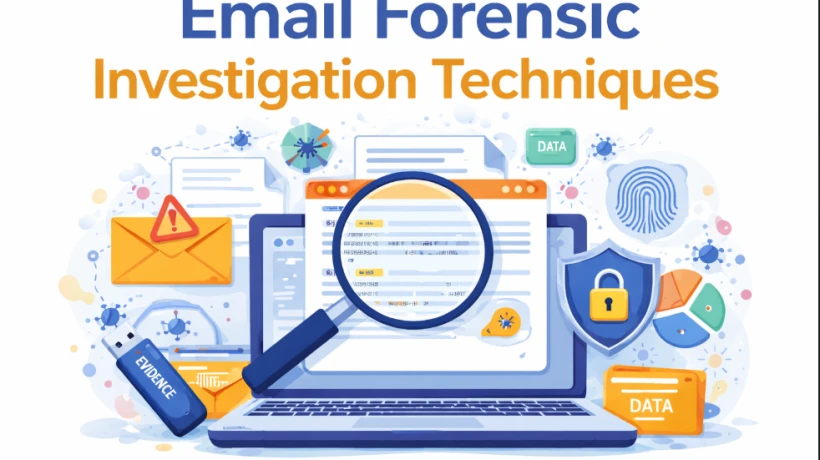
Blog Overview - Imagine a digital investigator examining a mailbox containing thousands of emails. Somewhere within those messages lies a single email that explains a financial fraud, a phishing attack, or an internal data leak. The difficulty is that the real evidence rarely appears in the visible text of the email.
Important clues are hidden inside technical details such as routing paths, timestamps, authentication records, and attachments. This is where email forensic investigation techniques become essential. They help investigators trace the origin of emails, uncover hidden information, and collect reliable digital evidence.
Understanding Email Forensics
Email forensics is a specialized area of cyber forensics focused on examining emails to determine their authenticity, origin, and transmission path. Investigators analyze various components of an email to understand how the message was created, where it came from, and whether it has been altered.
Think of an email like a package delivered through multiple postal centers. Every center records where the package arrived and where it was forwarded next. Emails work in a similar way. As they travel across servers and networks, they leave behind records that investigators can analyze later.
By examining these digital traces, forensic professionals can reconstruct the path of a message and identify the real sender. This information becomes extremely valuable in cybercrime investigations and legal cases. Due to these reasons complete understanding of digital forensic investigation techniques is important.
Key Email Forensic Investigation Techniques
Professional investigators use several proven techniques to extract information from email communications.
Email Header Analysis
The email header is one of the most important components of an email investigation. It contains detailed information about the sender, recipient, and servers involved in the transmission of the message.
Fields such as Message ID, Received records, SPF authentication results, and DKIM signatures help investigators verify the authenticity of the email and trace its route across the internet. By analyzing these fields, experts can often identify the originating server and detect spoofed messages.
Email Server Investigation
Email servers store logs that record how messages travel through the network. These logs may contain the sender’s IP address, timestamps, and authentication details.
Even when an email is deleted from a mailbox, traces of the message may still exist in server logs or backup systems. Examining these records can provide valuable clues during investigations.
Network Device Analysis
When server logs are unavailable or inaccessible, investigators may analyze logs from network devices such as routers, switches, and firewalls. These devices monitor network activity and can reveal how email data moved across the network.
This technique helps investigators reconstruct communication paths and identify suspicious connections.
Attachment Analysis
Email attachments are commonly used to spread malware or phishing links. During forensic investigations, attachments are carefully analyzed to detect malicious code, suspicious scripts, or altered documents.
Investigators may also examine file metadata to determine when the attachment was created and whether it has been modified.
Hash Value Verification
Preserving evidence integrity is essential in digital investigations. Hash algorithms such as MD5 or SHA-1 generate unique digital fingerprints for files. If the hash value changes, it indicates that the file has been modified.
Using hash values ensures that email evidence remains unchanged and can be safely presented in legal proceedings.
Importance of Email Forensic Investigation
Email communication plays a central role in business operations, legal documentation, and financial transactions. Unfortunately, it is also one of the most common channels used for cybercrime.
Effective email forensic investigation helps organizations and investigators detect phishing attacks, uncover insider threats, trace fraudulent communications, and gather reliable digital evidence.
By combining the right investigation techniques with modern forensic tools, investigators can analyze large volumes of emails efficiently and focus on identifying the evidence that truly matters.
Closing Thoughts
Email forensic investigation is no longer optional—it's a critical part of uncovering cybercrime, fraud, and insider threats. By carefully analyzing email headers, server logs, attachments, and metadata, investigators can reconstruct communication paths and gather evidence that holds up in legal proceedings.
The right combination of proven techniques and modern forensic practices ensures that no crucial detail goes unnoticed. Whether you’re handling corporate investigations or cybercrime cases, mastering these methods empowers professionals to uncover the truth quickly, efficiently, and reliably.
Effective email forensics transforms a complex, overwhelming inbox into a clear map of evidence, helping investigators solve cases with confidence and precision.
Related Posts
Can’t Import EML Files on Mac Mail? Here’s How to Solve It
In this article, we will discuss some of the methods to convert EML emails into Apple mail email clients.

Laptop repair in Roehampton: Techno-instant and dependable
Professional Laptop repair in Roehampton: Techno-instant and dependable

Professional Laptop repair in Roehampton: Techno-instant and dependable
Professional Laptop repair in Roehampton: Techno-instant and dependable

Comments (0)
Login to comment.
Share this post: